Australorp Chickens: The Complete Breed Guide
If you want one bird that does almost everything a backyard keeper actually needs — a lot of eggs, a gentle temperament, and a body hardy enough to shrug off a rough season — the Australorp is the breed most experienced keepers quietly recommend first. It holds a genuine world record for laying, it's calm enough to be a child's first chicken, and it asks very little in return. The catch is that most guides sell you the record and skip the parts that actually matter day to day — like the fact that this bird's biggest real-world risk is summer heat, not winter cold. This one won't: it's built on the breed's real history, the honest egg numbers, and lessons from our own Australorp flock.
Australorp chickens at a glance
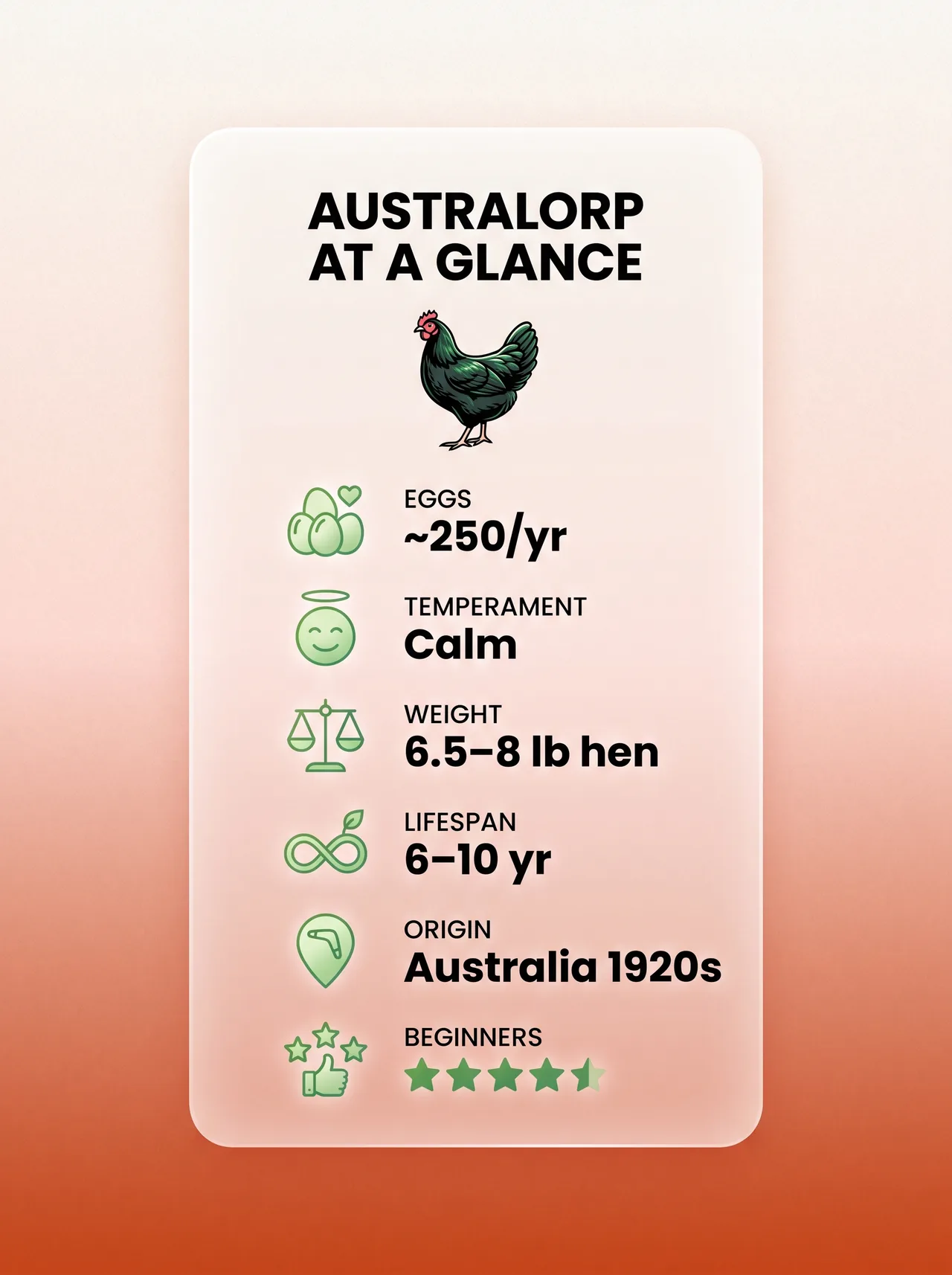
| Breed name | Australorp ("Australian Orpington") |
| Origin | Australia, 1920s — bred down from imported Black Orpington stock |
| Type | Dual-purpose heritage breed (eggs + meat) |
| Weight | Roosters ~8.5–10 lb; hens ~6.5–8 lb (bantams ~2–2.7 lb) |
| Eggs per year | ~250 light-brown eggs (world record: 364 in 365 days) |
| Egg size | Medium–large; starts laying ~5–6 months |
| Temperament | Calm, docile, friendly — excellent with children |
| Comb | Single comb |
| Hardiness | Cold-hardy; heat needs managing (heavy dark body) |
| Lifespan | ~6–10 years |
| APA recognized? | Yes — Black variety, admitted 1929 |
| Good for beginners? | Yes — one of the best first breeds |
Where the Australorp comes from (and the world record that made its name)
The name is a contraction of "Australian Orpington," and that's exactly what the breed is. In the early 1900s, Australian breeders took imported Orpington stock — the big, soft-feathered English utility bird — and, over the following decades, selected hard in a different direction: away from the show ring and toward sheer laying ability, with a little influence from Rhode Island Red, Minorca, Langshan, White Leghorn and Plymouth Rock lines along the way. By the 1920s they had produced something new: a black, dual-purpose bird that could out-lay almost anything of its size.
Then came the moment that made the breed famous. In Australian laying trials of the 1920s, a team of six Australorp hens averaged more than 300 eggs each in a year, and one hen laid 364 eggs in 365 days — a record set on nothing but good management and daylight, no artificial lighting. That number is real, and it's the reason the Australorp still gets called the world's best laying breed. Just keep it in perspective: it was a record under trial conditions, not a promise about your backyard hen (more on the honest numbers below). The breed reached the United States and was officially recognized by the American Poultry Association in 1929, in the Black variety only.
One happy footnote: the Australorp was once considered a breed worth conserving, but its popularity with backyard keepers has brought its numbers roaring back. In 2023 the Livestock Conservancy graduated it off their Conservation Priority List — a heritage-breed success story, and a good sign of just how many keepers have discovered how easy this bird is to live with.
What an Australorp looks like
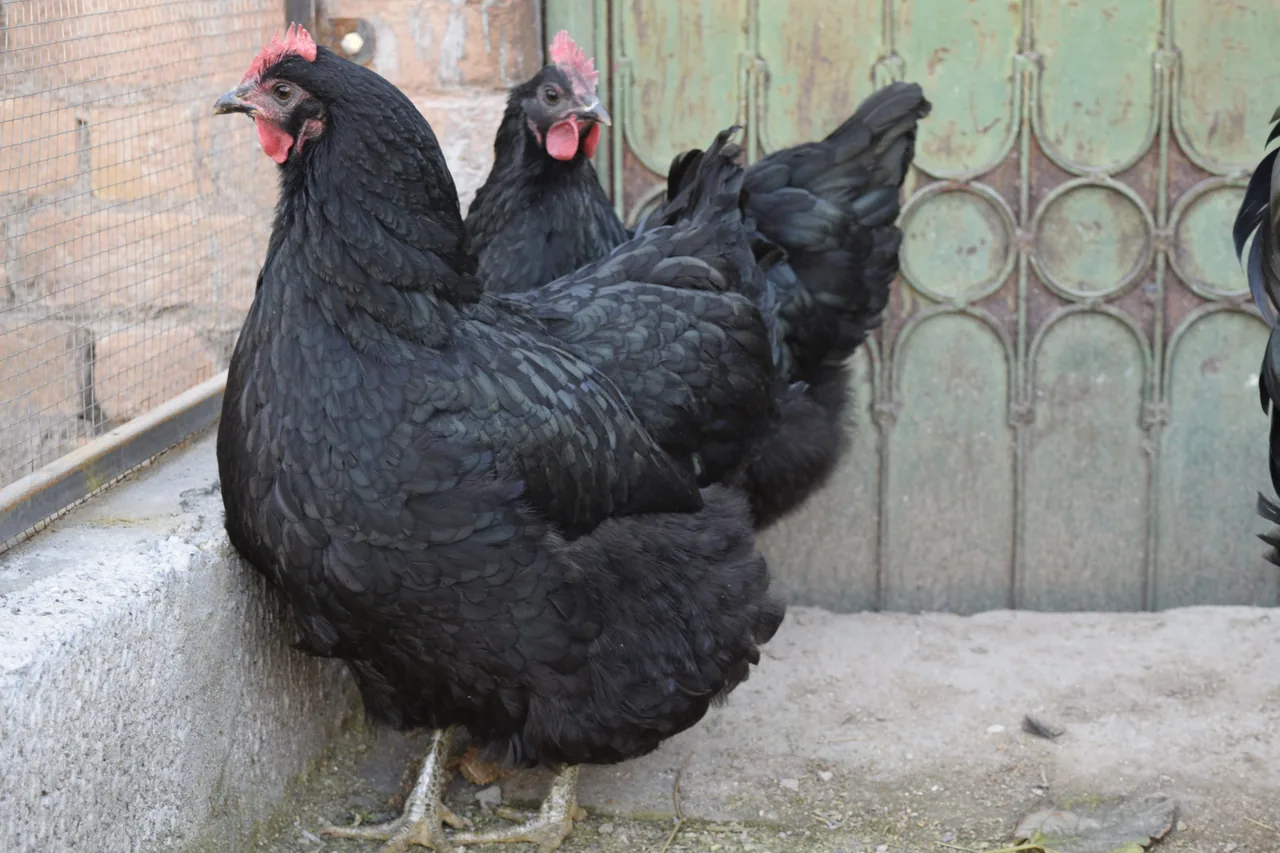
A good Black Australorp is a genuinely beautiful bird, though you have to catch it in the right light to see why. From a distance it reads as solid, glossy black. In direct sunlight that black lights up with an intense beetle-green sheen — a deep, iridescent green that's the mark of well-bred stock. They're a substantial, well-rounded bird with an upright, friendly carriage, a single comb, and dark eyes.
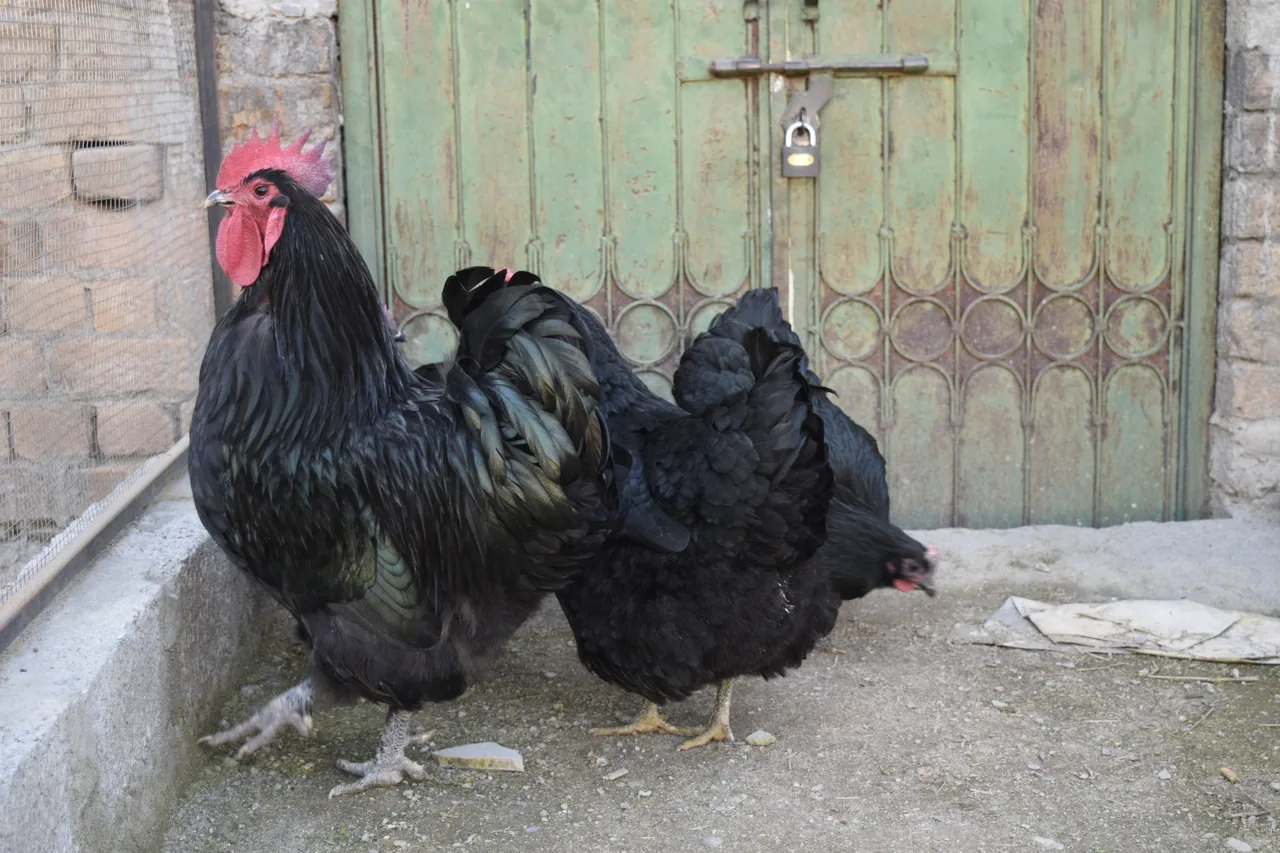
In the United States, black is the only variety the APA recognizes, and it's by far the most common. You'll also see blue, white, and other colors sold — they're real birds and can be lovely, but they aren't part of the American standard, so if breed-standard purity matters to you, black is the one to ask for. Standard hens weigh around 6.5–8 lb and roosters 8.5–10 lb, with a bantam version at roughly a third of that size for keepers short on space.
Australorp egg production: the honest numbers
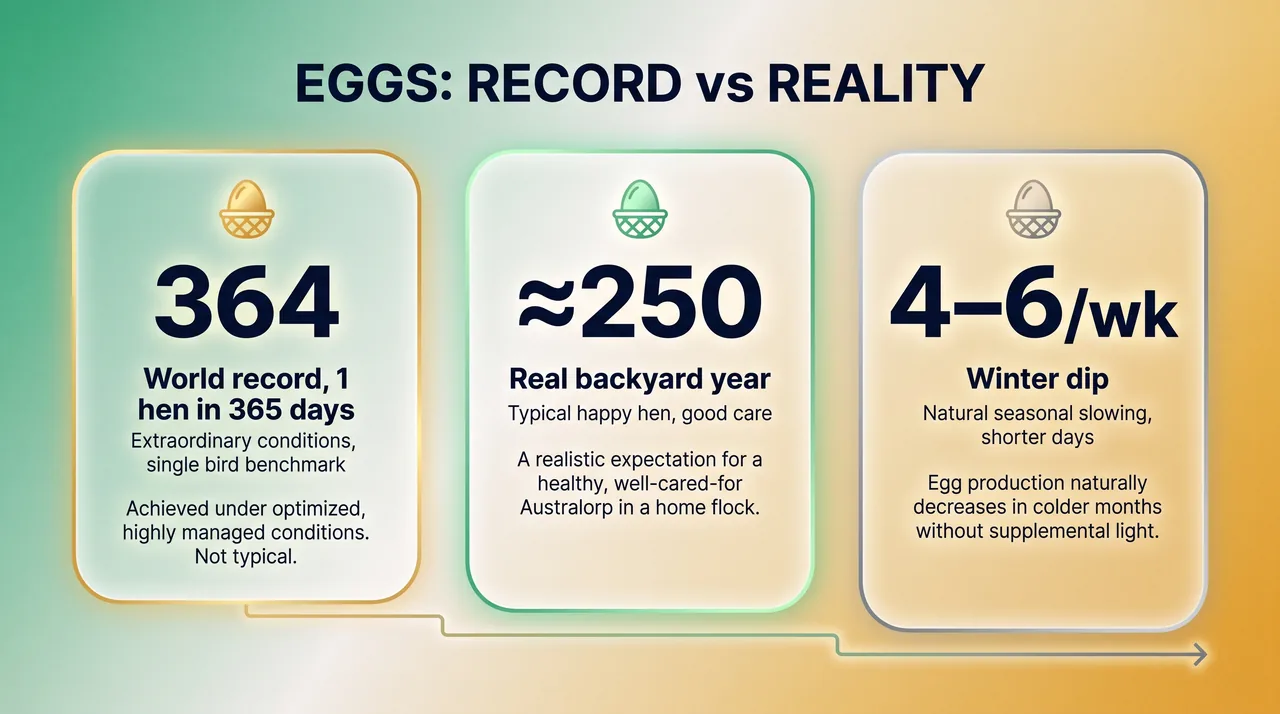
Here's where realistic expectations matter, because the record does the breed a small disservice. Yes, an Australorp can lay in the 300s under ideal trial conditions. What you'll actually see in a backyard is closer to 250 medium-to-large, light-brown eggs a year from a good hen — still an excellent number, comfortably five eggs a week from a bird in her prime, and more than enough to keep a family in eggs. They mature quickly too, often starting to lay around five to six months old. And unlike an ultra-rare heritage layer such as the Deathlayer, an Australorp is easy to find and effortless to keep.
That rate isn't a flat line, though. Laying rises and falls with a hen's health, her stress level, the season, and her age — it dips in the short days of winter, stops almost completely during the annual molt, and tapers gradually as a hen gets older. The keepers who get the most eggs aren't doing anything exotic; they're keeping calm, healthy, unstressed birds with steady daylight, good feed, and clean water.
🐔 From our coop
Across our own flock of twenty Australorps, laying capacity came down almost entirely to the hens' health and stress levels. In the happiest, best-settled birds we saw around five to seven eggs a week, dropping to four to six a week through winter. Interestingly, our hens laid a light off-white egg of about 45–50 grams rather than the classic deep brown — a good reminder that real flocks vary from the breed-card description, and that a calm, well-run coop does more for your egg basket than any single "trick."
Temperament: the reason to keep them
If the eggs are the headline, the temperament is why people fall in love with the breed. Australorps are calm, quiet, and genuinely docile — unhurried birds that tolerate handling well, rarely start trouble, and settle happily into the middle of the pecking order. That combination makes them one of the best breeds for families: they're patient with children, easy for a nervous first-time keeper to manage, and content whether they're free-ranging or in a run.
The flip side of a gentle nature is that Australorps can be bullied by pushier breeds. Drop them in a flock ruled by assertive birds like Rhode Island Reds and your Australorps may get shoved off the feeder rather than fight back. It's rarely a serious problem, but it's worth watching when you're mixing breeds — give everyone enough space, feeder stations, and hiding spots.
🐔 From our coop
We kept a flock of twenty Australorps with a single rooster, and their cool temperament plus that outstanding laying is exactly why they were our go-to breed. Two things kept them content. First, they love to perch up high to rest and lounge — so we built a simple bamboo structure four to five feet off the ground, and they adored it. Second, we always kept birds of the same age and growth stage together, and quietly moved on any that didn't meet our standard. Keeping the flock evenly matched like that removes a huge amount of stress and keeps the whole group calm and laying.
Care and housing: the heat caveat nobody mentions
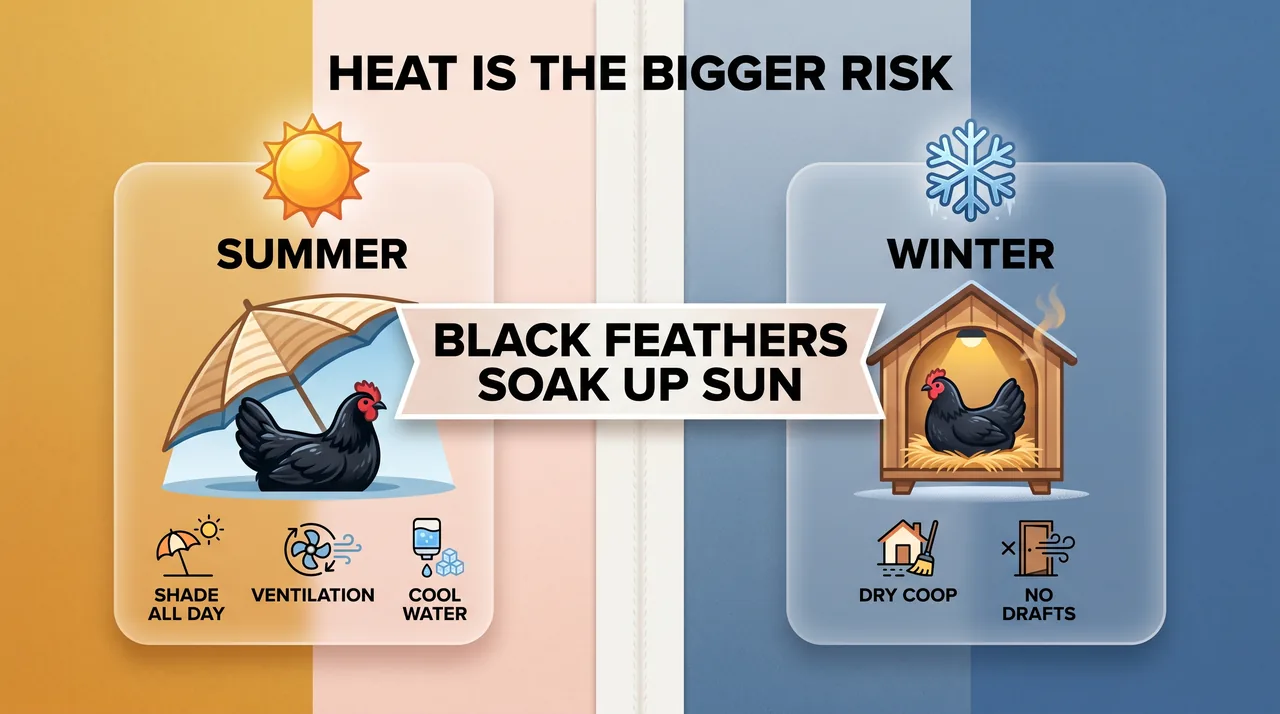
Australorps have a reputation as a tough, cold-hardy heritage bird, and they are — but lead with cold and you'll miss the risk that actually catches keepers out. That heavy body and jet-black plumage absorb heat, so summer, not winter, is often the season to plan around. Dark feathers soak up sunlight, and a big bird carries a lot of insulation, which means an Australorp can overheat on a hot day faster than a lighter breed. Guard against it with the simple things: reliable shade all day, a spot to free-range in the shadows, cool water, and good coop ventilation.
None of that means they're delicate in the cold — they handle it well — but "cold-hardy" is not the same as "leave them to it." A damp, poorly ventilated coop will make a winter bird sick regardless of how hardy the breed is, so keep them dry and draft-free and their natural toughness does the rest. For the full picture on both ends of the thermometer, see our guide to the ideal temperature for chickens.
🐔 From our coop
In our experience, Australorps were actually more heat-hardy than cold-hardy — you have to be on your toes for them catching a chill in winter, and a healthy, well-kept coop is what carries them through it. Because their black color pulls in the sun, a little temporary shade or a shaded spot to range in through summer, along with good ventilation, made all the difference. They reward the extra attention: looked after properly, they really are gems to keep.
One more thing the docile, food-loving nature sets up: Australorps put on weight easily. A calm bird that tolerates confinement and never turns down a treat can drift into obesity if it's penned up and over-fed, and a fat hen lays worse. Give them room to move — a run they'll actually use, or supervised ranging — and go easy on the treats. As with any breed, predator protection is non-negotiable: a secure, well-built run and a coop closed up at night matter far more than the breed you keep. Experienced keepers are blunt about one detail here — ordinary chicken wire only keeps birds in, not predators out; a run built from hardware cloth (or ringed with electric poultry netting) is what actually stops a determined raccoon or fox.
🐔 From our coop
Our hardest-won lesson was about disease, not predators. The moment a bird caught a chill or showed signs of infection, we'd immediately quarantine it, disinfect the coop, change the bedding, and vaccinate the whole flock as a precaution — on top of routine periodic vaccination. Move fast and you keep your losses to one bird; hesitate and a single sick hen can take others with her. Bedding, by the way, isn't one-size-fits-all — what works depends on the season you're in, so match it to the weather rather than picking one material forever (our coop bedding comparison breaks down the options).
Raising Australorp chicks
Australorps are a robust, healthy breed with no ailments specific to them, but the chick stage is the exception to every breed's easy reputation — chicks are the most demanding age group there is, and Australorps are no different. They need the basics done right and done consistently: a warm, dry, clean brooder, constant fresh water, good chick feed, and daily eyes-on attention. A simple DIY brooder box does the job until they're feathered enough to move on.
The single most useful habit is watching for the ones falling behind. In any hatch a few chicks lag on growth or struggle to feed, and they'll go downhill quickly if they're left to compete with stronger hatchmates. Pull those birds aside and give them separate, extra care — a quieter space, easy access to food and water, sometimes a vitamin boost — and many of them catch up fine.
🐔 From our coop
Chicks were always the most difficult stage for us, whatever the breed. A DIY brooder box was our go-to until they were about a month old. The rule that mattered most: watch for the chicks with growth or feeding problems and separate them early — they need isolated, extra attention, and you lose them the moment you stop looking closely. Consistent, hands-on care is the whole game at this age.
Health and lifespan
Grown Australorps are as low-maintenance as chickens get. They're a hardy heritage breed with no breed-specific health problems, and with good care they live a solid 6–10 years. Your real watch-items aren't diseases unique to the breed — they're the two things this guide keeps circling back to: don't let them overheat, and don't let them get fat. Beyond that, the ordinary good habits apply: routine parasite checks, clean water, a dry coop, and prompt quarantine of any sick bird — the same evidence-based basics the university extension services (such as Poultry Extension) recommend for any small backyard flock. For the wider set of things that lengthen or shorten a chicken's life, see our guide to the factors that affect a chicken's lifespan.
Are Australorps good for beginners?
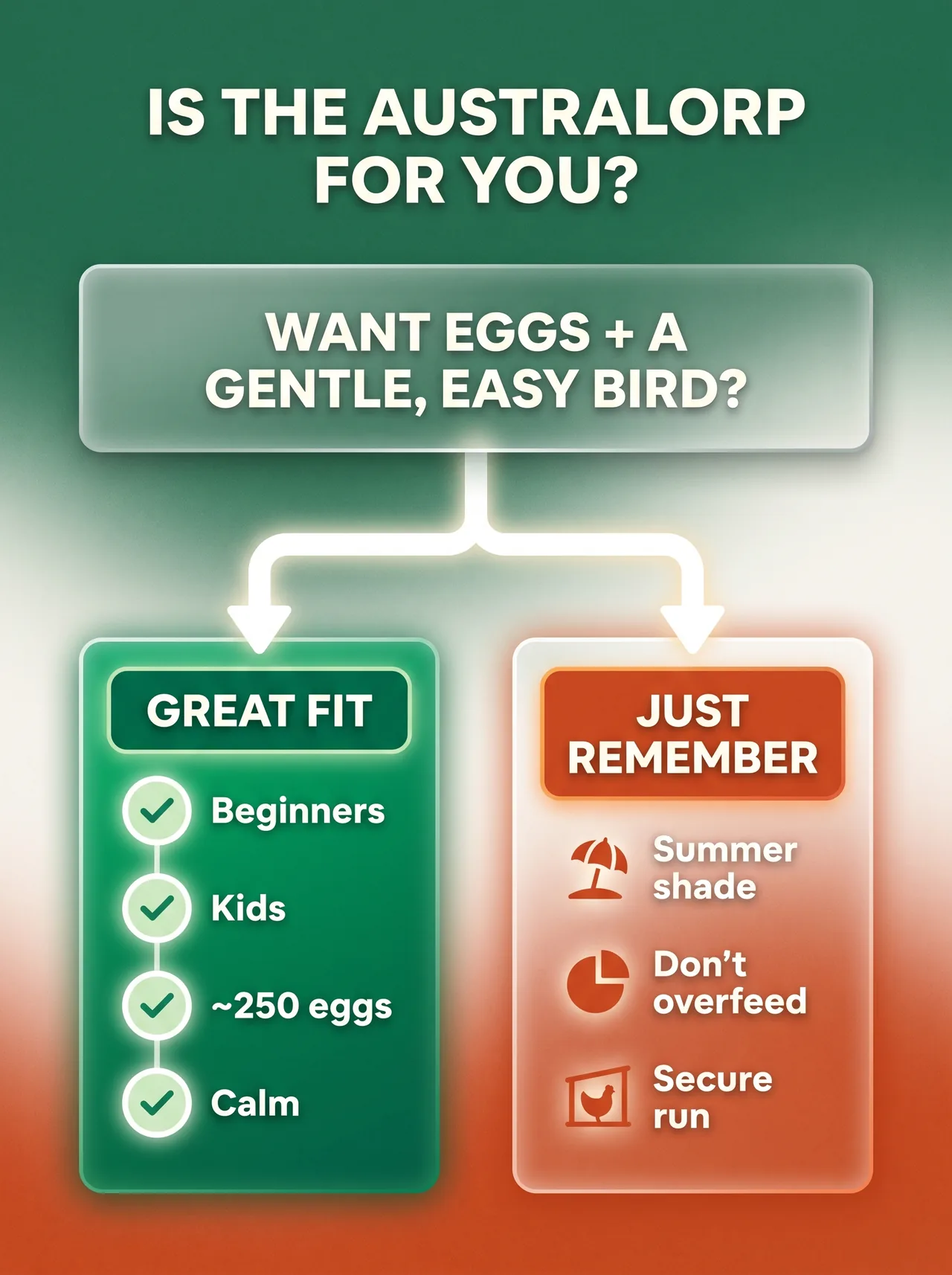
Yes — few breeds make a stronger case as a first chicken. They lay generously, they're calm and forgiving of a new keeper's learning curve, they're hardy, and they're gentle enough for kids. If you want one breed that covers most of what a backyard flock is for, this is close to the default answer. The only homework is respecting what makes them tick: shade in summer, a dry coop in winter, room to move so they don't overeat, and a secure run.
🐔 From our coop
Our honest advice to any beginner is simple: know your breed before you keep it, and raise your birds the smart way — not carelessly. These days that includes leaning on technology: a smart, AI-enabled coop camera and a basic coop-management system can flag what's going wrong inside the coop long before it costs you a bird. A gentle, generous breed like the Australorp rewards a keeper who pays attention — so set yourself up to actually pay attention.
Frequently asked questions
How many eggs does an Australorp lay per year?
Around 250 light-brown eggs a year from a healthy backyard hen — roughly five a week in her prime. The breed's world record is 364 eggs in 365 days, but that was set under laying-trial conditions; 250 is the honest real-world figure.
What color eggs do Australorps lay?
Classically a light-to-medium brown. Real flocks vary, though — our own hens laid a light off-white egg of about 45–50 grams, a reminder that individual birds don't always match the breed card.
Are Australorps good with children?
Very. They're calm, docile, and patient with handling, which makes them one of the most popular family and first-flock breeds.
Are Australorps heat tolerant?
They handle heat, but their heavy body and black feathers absorb sunlight, so they can overheat on hot days. Provide all-day shade, cool water, and good ventilation — summer needs more planning than winter for this breed.
Do Australorps go broody?
Occasionally. They're not famous brooders the way Silkies are, but individual hens will sit, so it's realistic to expect the odd broody bird rather than reliable hatching.
What colors do Australorps come in?
Black is the only variety recognized by the American Poultry Association in the US, and the most common. Blue, white, and other colors exist but aren't part of the American standard.
How long do Australorps live?
Typically 6–10 years with good care — a hardy, long-lived heritage breed with no ailments specific to it.
More from our flock
The advice above comes from years of keeping Black Australorps first-hand. You can see more of our own birds — and the coop setups referenced throughout this guide — on our YouTube channel, Backyard Eggcellency.
Whatever draws you to the breed — the generous laying, the beetle-green sheen, or simply the calmest temperament in the coop — the Australorp is one of the most rewarding birds a backyard keeper can start with. Give it shade in summer, a dry coop in winter, and room to stay trim, and it'll fill your egg basket for years.